
Ever opened a quarterly water bill and wondered if it's normal? Here's how the big providers charge, a quick estimator for your own bill, who pays what when you rent, and how to catch a leak before it costs you.

Written by Alex BFounder of Money Detective. Published 21 November 2026.
The honest answer is that there's no single "average water bill" in Australia. Your bill depends on who supplies your water, how your provider charges, and whether you own or rent. So instead of a made-up national number, this guide gives you the real prices and a way to check your own.
Jump to the water bill estimator
Electricity has national reference prices. Water doesn't. Your water and sewerage services come from a local provider, often owned by a state government or a council, and each one sets its own prices with its own regulator.
Most water bills are made of two parts:
The mix varies a lot. In some cities fixed charges are most of the bill; elsewhere it's usage. That's why a national "average" can mislead.
The Bureau of Meteorology compares providers every year in its National Performance Report. In the 2024–25 report, the median typical residential bill rose 7.6% when small providers reporting for the first time were included. Leave those new providers out and the median was largely unchanged. Either way, the report shows a huge spread between the cheapest and dearest providers, so your own bill is the number that matters.
Prices below are from each provider or regulator for 2026–27, unless marked. Most providers change prices on 1 July each year, so check the dates on your own bill.
| Area and provider | Fixed charges | Usage charge | Good to know |
|---|---|---|---|
| Sydney, Illawarra, Blue Mountains: Sydney Water | Water service $26.65 a quarter; wastewater service $189.88 a quarter; stormwater $30.26 a quarter for houses in some areas | $3.41 per kL | A typical Sydney Water household uses about 200 kL a year |
| Brisbane, Ipswich and surrounds: Urban Utilities | Daily water and sewerage service charges | Urban Utilities' own usage price (2025–26: $0.981 per kL for the first 822 litres a day) plus the State Bulk Water Charge of $3.517 per kL | The Queensland Government has frozen the bulk water price for two years, and Urban Utilities is passing that on |
| Canberra: Icon Water (prices set by the ICRC) | Water supply charge $258.27 a year, plus a sewerage supply charge | $2.94 per kL for the first 50 kL a quarter, then $5.91 per kL | A typical 200 kL a year customer pays about $1,531 in 2026–27 |
| Central Coast NSW: Central Coast Council (prices set by IPART) | Service charges | Usage charges | A typical household using 170 kL a year pays about $1,565 in 2026–27 |
| South Australia: SA Water | Water supply charge (2025–26: $329.20 a year, billed $82.30 a quarter) | Tiered usage | Most customers pay the same price per kL wherever they live in SA |
| Western Australia: Water Corporation | Set by the State Government each year | Tiered usage | Residential wastewater charges are based on the property's gross rental value |
| Melbourne: Yarra Valley Water, South East Water, Greater Western Water | Water and sewerage system charges, billed quarterly to owners | Water and sewer usage per kL | Both owners and renters pay usage charges |
Prices change each year. Your bill shows the exact charges for your property, and your provider's website lists the current year's prices.
Pop in how many people live with you and the prices from your bill. You'll see your usage in kilolitres, your quarterly bill and, most usefully, what to set aside each fortnight.
How this works: people × litres per person per day × 91 days ÷ 1,000 = kilolitres a quarter. Usage cost = kilolitres × your price per kL. Add your fixed charges (left out if you rent and your landlord pays them). Per fortnight = quarterly bill × 4 ÷ 26. 182 litres per person a day is Sydney Water's figure for a typical household; change it if you know your own. Tiered prices aren't modelled, so if your provider charges more above a set amount, use your bill's average price. Your figures stay in your browser.
3 people using 182 litres each a day is about 49.7 kL a quarter. That's $169.43 in usage, plus $216.53 in water and wastewater service charges, so about $385.96 a quarter, or $59.38 a fortnight.
As a renter you usually won't get a bill straight from the water provider. The owner gets it and passes on your share.
Under the Residential Tenancies Authority rules, the owner can pass on full water usage, including the State Bulk Water Charge, only if all three are true:
The owner always pays the fixed water supply charges. If the home isn't water efficient but is individually metered, the owner pays for a "reasonable amount" and you may be charged for anything above it, as long as your agreement spells that out. You have 4 weeks to pay after you receive the bill.
NSW, Victoria and the other states have similar rules: owners pay fixed charges, and renters may pay usage when the home is separately metered and meets water-efficiency rules. The details differ, so check your state's tenancy authority before you pay a water bill you're not sure about.
Getting a Centrelink payment? You can pay water bills through Centrepay. Our guide to Centrepay explained shows what you can still pay with it and how to budget what's left.
Some unit blocks share one water meter. Without your own meter, it's hard to be charged fairly for your own usage, so check your lease or ask your property manager how water is split.
A running toilet or dripping tap can waste water all quarter without you noticing. This test takes two minutes at night and two in the morning.
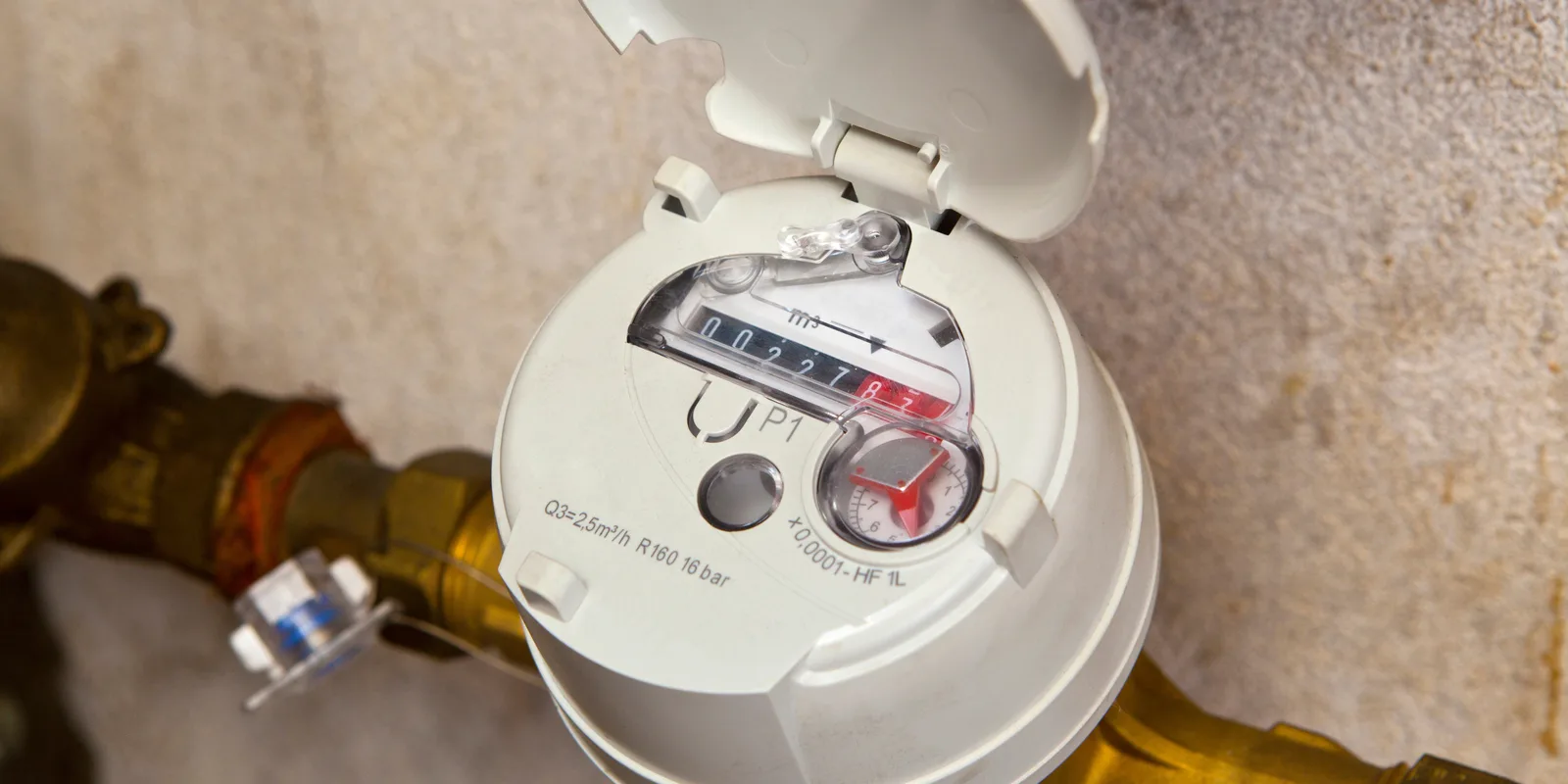
The red numbers and the small dial move with every litre, so they're the ones to watch.
Quick checks if it moved:
If you rent, tell your property manager in writing. Owners with a large bill from a hidden leak may be able to get help from their water provider.
A quarterly bill is easiest to manage when you've paid it bit by bit before it lands.
| Example (example figures only) | Amount |
|---|---|
| Yearly water bill | $1,240 |
| Each quarter | $310 |
| Each fortnight | $47.69 |
Move $47.69 into your bills account every payday and the next water bill is already covered. Want to see every household bill as one fortnightly number? Our guide to average household bills in Australia has a calculator that adds up power, gas, water and internet.
Setting up a bills account for the first time? Our guide to how to organise bills walks you through it in 4 steps.
All Money Detective spreadsheets are Microsoft Excel (.xlsx) files for Mac or Windows. No bank login, no subscription.
There isn't one national figure, because each provider sets its own prices. As examples, Canberra's regulator puts a typical 2026–27 bill at about $1,531 a year for 200 kL, and IPART puts a typical Central Coast bill at about $1,565 for 170 kL. Your own bill and the estimator above are the best guide.
Often, but usually just the usage part. In Queensland, for example, the owner pays the fixed charges, and the tenant can be charged for usage only if the home is individually metered, water efficient, and the lease says so.
A leak, more people at home, garden watering, a longer billing period, or a new financial year's prices. Do the overnight meter test to rule out a leak first.
Most providers bill quarterly. Many offer monthly or fortnightly payment options if you'd rather pay smaller amounts.
This article provides general information only. It does not take into account your personal objectives, financial situation or needs, and it is not financial advice. Prices are from each provider's or regulator's published 2026–27 charges unless marked, and can change. Check your own bill and your provider's website. Figures checked 21 November 2026.