 ← All Money Detective articles
Budgeting & household bills
← All Money Detective articles
Budgeting & household bills
How to Budget for Annual Bills Without Getting Caught Out
Rego, insurance, rates and school costs do not arrive every month, but they are usually predictable. Here is a simple way to work out how much to set aside each payday so they are less of a shock.

Written by Alex BPublished 1 October 2026
Money Detective is built around practical household money tools for Australians.

Some bills turn up every month and become part of the routine. Others only arrive once or twice a year: car registration, insurance renewals, council rates, school costs, memberships. Because they are not in front of you every month, they can feel like a surprise, even when you knew they were coming.
The good news is that most of these costs are predictable. You usually know roughly what they cost and roughly when they are due. That means you can plan for them a little at a time, instead of finding the whole amount in one pay.
Annual bills are infrequent, not unexpected
It helps to separate two kinds of costs:
- Infrequent but predictable costs, such as rego, annual insurance premiums, council rates, school fees and annual subscriptions. You may not pay them often, but you can usually see them coming.
- Genuinely unexpected costs, such as an urgent car repair or a broken appliance. These are what emergency savings are generally for.
Moneysmart suggests including irregular costs, such as car repairs and services, annual bills and pet costs, when you build a budget. Planning ahead for the predictable ones means your emergency savings are less likely to be used up by a bill you already knew about.
How to budget for annual bills, step by step
- List your irregular and annual expenses. Go through several months of bank and credit-card statements, and think about anything paid quarterly, six-monthly or once a year. Not sure what to include? Start with the Australian household bills checklist.
- Record the expected amount. Use last year's bill or renewal notice as a starting point. If you expect it to go up, use a slightly higher figure.
- Record when each one is due. The due date matters as much as the amount.
- Count the paydays left before each due date. If you are paid fortnightly and a bill is due in four months, you might have around eight paydays to prepare.
- Work out how much is still needed. Take the expected amount and subtract anything you have already put aside for it.
- Divide the amount still needed by the paydays remaining. That is the amount to set aside each payday for that bill.
- Make it part of your payday plan. Treat it like any other bill that needs covering from this pay.
- Review it when things change. If a renewal notice comes in higher, or a due date moves, recalculate.
The simple conversion: spreading a bill over a full year
If a bill is a full year away, a quick way to see what it costs each pay cycle is to divide the annual amount by the number of pay periods in a year:
- Weekly: annual amount ÷ 52
- Fortnightly: annual amount ÷ 26
- Monthly: annual amount ÷ 12
| Annual expense | Weekly | Fortnightly | Monthly |
|---|---|---|---|
| $520 | $10.00 | $20.00 | $43.33 |
| $780 | $15.00 | $30.00 | $65.00 |
| $1,040 | $20.00 | $40.00 | $86.67 |
| $1,300 | $25.00 | $50.00 | $108.33 |
| $2,600 | $50.00 | $100.00 | $216.67 |
Monthly amounts are rounded to the nearest cent.
A fortnightly pay cycle usually has 26 paydays in a year, although the ATO notes that a financial year sometimes has 27. Dividing by 26 is a sensible planning estimate either way.
When the bill is due sooner than 12 months away
The full-year conversion only works if you start saving a full year ahead. In real life, you often notice a bill when it is a few months away. In that case, dividing by 26 will not be enough to have the money ready in time.
The calculation that actually matters is:
Example: car insurance due in 8 fortnights
Your car insurance renewal is expected to be $780. It is due in 8 fortnightly paydays, and you already have $200 put aside for it.
Amount still needed: $780 − $200 = $580
Per payday: $580 ÷ 8 = $72.50 each fortnight
Using the full-year conversion instead ($780 ÷ 26 = $30.00) would leave you well short by the due date. Once this renewal is paid, you can drop back to $30.00 a fortnight to get ready for next year's bill, assuming the price stays the same.
When several bills are due close together, add up the per-payday amounts for each one. If the total is more than this pay can comfortably cover, it is better to know now. You may be able to ask the provider about paying in instalments, or adjust other parts of your plan. Moneysmart notes that some providers let you pay bills in smaller amounts, such as fortnightly or monthly, to avoid one large bill.
Where to keep the money
Some people move the amount into a separate savings or bills account each payday, so it is less likely to be spent by accident. Moneysmart suggests setting up a separate account for bills as one option. Others simply track it in their budget. The method matters less than making the amount visible and setting it aside consistently.
Common annual and irregular bills to plan for
- Car registration and compulsory third party insurance (how this is paid varies by state and territory)
- Car, home and contents, and other insurance paid annually
- Council rates and water charges
- School fees, uniforms, books and camps
- Car servicing and tyres
- Annual subscriptions and memberships
- Dental and optical costs
- Pet registration and vet care
- Christmas, birthdays and other planned occasions
Only include what applies to your household. For a fuller list, see the household bills checklist. If you like the idea of a separate pot for each cost, our guide to sinking funds in Australia explains how to set them up.
Making it part of every payday
Working out these amounts once is helpful. Keeping them up to date every payday, as due dates get closer and bills are paid, is where it can get fiddly.
Payday Buffer is a Money Detective spreadsheet built for this. On its Upcoming Expenses tab you add each cost, how often it comes up, the expected amount, when it is next due and anything already saved. It spreads the amount still needed across the paydays left and shows what to put aside from this pay, then rolls repeating costs forward once their due date passes.
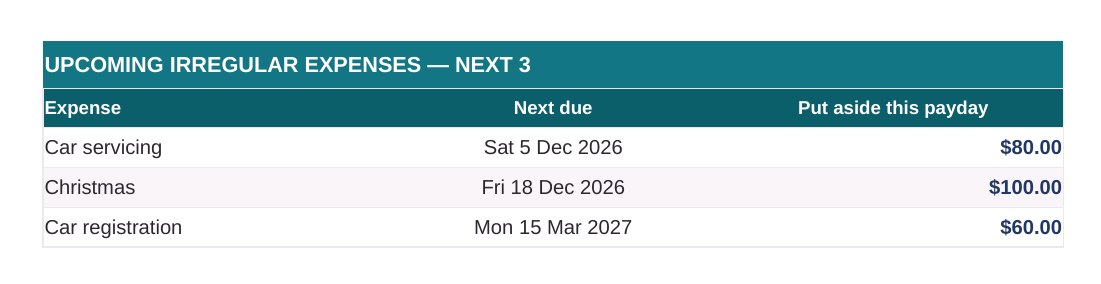
Example figures from the Payday Buffer workbook.
If you would rather start with a quick, free check of what this pay needs to cover, try the free Payday Check. For a full budget that compares what you planned with what you actually spent each pay cycle, the free Money Detective budget spreadsheet is a good starting point.
Official sources and further reading
This article provides general information only. It does not take into account your personal objectives, financial situation or needs, and it is not financial advice. Money Detective's tools provide estimates and planning information. Consider your own circumstances, and seek independent advice if you need it, before making financial decisions.