 ← All Money Detective articles
Budgeting & saving
← All Money Detective articles
Budgeting & saving
Sinking Funds Australia: How Much Should You Put Aside Each Payday?
A sinking fund is money you put aside each payday for a cost you know is coming. Here is how to choose your funds, work out the right amount, and adjust when a bill is due sooner than you would like.

Written by Alex BPublished 1 October 2026
Money Detective is built around practical household money tools for Australians.

A sinking fund is money you set aside, a little at a time, for a cost you know is coming. Instead of finding $850 for rego in one pay, you put away a smaller amount each payday so the money is there when the bill arrives.
The name sounds technical, but the idea is simple. It is a way to give a future expense its own pot of money, so it does not compete with this fortnight's groceries.
What can a sinking fund be used for?
Sinking funds work best for costs that are known, or reasonably easy to foresee. Common examples include:
- Car registration
- Annual insurance premiums
- Car servicing and tyres
- Christmas and birthdays
- School costs, uniforms and camps
- Annual memberships and subscriptions
- Dental and optical costs
- Home maintenance
- Pet registration and vet care
You do not need a fund for every category. Start with the two or three costs that tend to catch your household out, and add more if it helps. The household bills checklist is a good place to spot them.
Sinking funds and emergency savings are not the same thing
A sinking fund is generally for an expense you expect, or have decided to plan for: rego, Christmas, a holiday. Emergency savings are generally for costs you did not see coming. Moneysmart describes an emergency fund as money saved to cover urgent or unexpected costs, such as car repairs, unexpected travel or an urgent medical bill.
Keeping the two separate can make each one easier to manage. When rego is paid from its own sinking fund, your emergency savings stay available for real surprises. How much to keep in emergency savings depends on your circumstances, and Moneysmart's guide is a useful place to start.
Worked example: four sinking funds
Say a household wants to plan for these costs over the next year:
| Expense | Expected cost | Per fortnight (÷ 26) |
|---|---|---|
| Car registration | $850 | $32.69 |
| Car insurance | $1,500 | $57.69 |
| Christmas | $1,200 | $46.15 |
| School costs | $600 | $23.08 |
| Total | $4,150 | $159.62 |
Example figures only. Individual amounts are rounded to the nearest cent, so they add to $159.61. The total is $4,150 ÷ 26 = $159.62.
If every one of these costs were exactly a year away, putting aside $159.62 each fortnight across 26 fortnightly paydays would cover them all.
Why real life usually needs different amounts
Bills rarely line up that neatly. Some will be due in a few weeks, others in eleven months. If a bill is close and nothing has been saved yet, the even amount will not get you there in time.
Example: rego due in 6 paydays
Rego is $850, it is due in 6 fortnightly paydays, and nothing has been saved yet.
$850 ÷ 6 = $141.67 per payday
That is very different from $850 ÷ 26 = $32.69. If you only put aside $32.69 a fortnight, you would have about $196 saved when the $850 bill arrives.
If you already had $100 put aside, the amount still needed is $750, and $750 ÷ 6 = $125.00 per payday.
The rule of thumb that works for any sinking fund is:
Once a bill is paid, the next year's fund can usually drop back to the smaller even amount, because you have a full year to save again. Our guide to budgeting for annual bills walks through this step by step.
How to set up sinking funds
- Choose the costs. Pick the ones that matter for your household.
- Write down the expected cost and due date for each.
- Note what you have already saved towards each one.
- Work out the per-payday amount using the formula above.
- Decide where the money will sit. Some people use a separate savings account, others use one account and track each fund in a spreadsheet. Moneysmart suggests a separate account for bills as one option.
- Set it aside on payday, before the rest of the pay gets spent.
- Update it when a bill is paid, a price changes or a new cost comes up.
Keep it manageable. If the total per payday is more than your pay can cover right now, it is better to know that early. You might start with the nearest bills, ask a provider about paying in instalments, or adjust other parts of your budget.
Let a spreadsheet keep the numbers up to date
The maths is simple for one fund. It gets fiddlier when you have several, each with its own due date and balance, and the amounts change every payday.
Payday Buffer is a Money Detective spreadsheet that handles this as part of your payday plan. You add each upcoming cost once, with how often it comes up (monthly, quarterly, six-monthly, annual or one-off), the expected cost, when it is next due and anything already saved. It spreads the amount still needed across the paydays left, shows what to put aside from this pay, and rolls repeating costs forward once their due date passes.
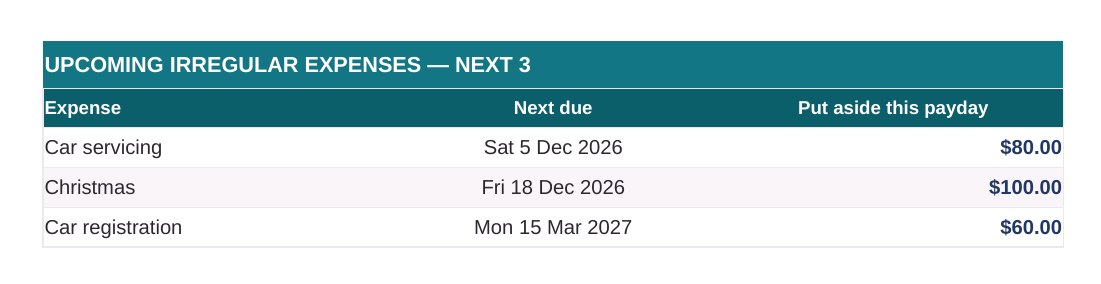
Example figures from the Payday Buffer workbook.
Not ready for that? The free Payday Check shows what one pay needs to cover, and the free budget spreadsheet helps you plan your whole fortnight.
Official sources and further reading
This article provides general information only. It does not take into account your personal objectives, financial situation or needs, and it is not financial advice. Money Detective's tools provide estimates and planning information. Consider your own circumstances, and seek independent advice if you need it, before making financial decisions.